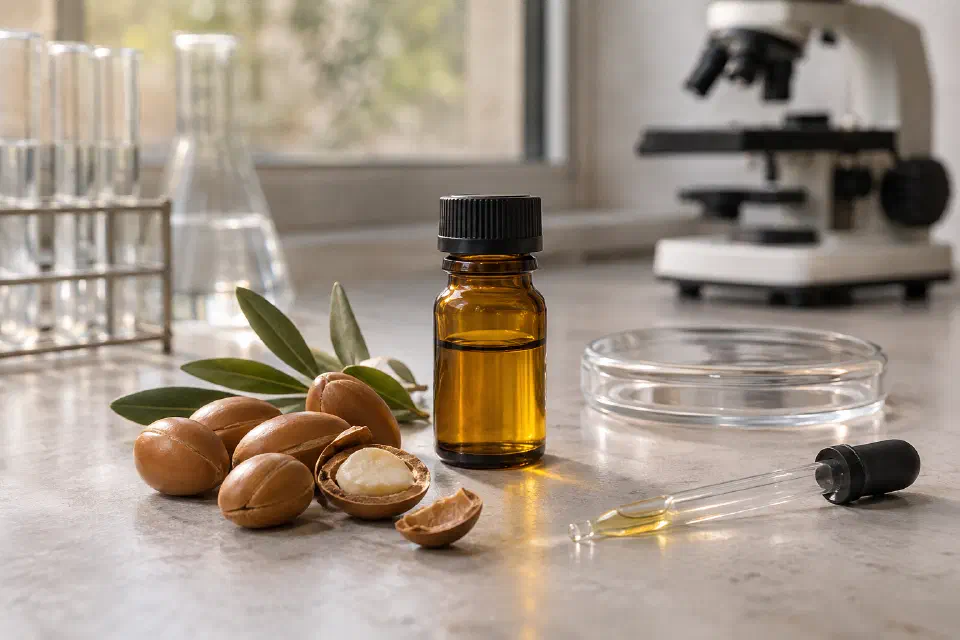
Does argan oil protect against prostate cancer? Testing oil components on cancer cells cannot establish that it does. To understand a paper, we need to know exactly what was tested and what was measured. That matters more than a promising headline or a claim on a label.
What was actually tested?
Bennani and colleagues tested polyphenols and sterols extracted from argan oil on three prostate cancer cell lines. They observed reduced cell proliferation under laboratory conditions. This was neither a patient treatment trial nor a study of people consuming the oil. Bennani and colleagues, 2007.
“Human cells” describes the biological origin of the material. It does not mean the experiment involved human participants. Likewise, “antiproliferative activity” means inhibition of multiplication in a particular model; it does not by itself establish an effective medicine.
Does argan oil still have beneficial properties?
Yes: research covers areas other than cancer. A meta-analysis of five randomised trials involving 292 participants found favourable lipid changes, including lower LDL and triglycerides. The authors called for larger studies of actual cardiovascular outcomes. Systematic review and meta-analysis, 2018.
This supports interest in argan as a dietary ingredient. It does not connect better lipid markers with prostate-cancer prevention: those are separate questions requiring different studies.
In everyday use, the overall diet and which fats the oil replaces matter. Do not increase intake hoping for an anticancer effect. Its flavour and nutritional role can be appreciated while keeping the limits of current evidence clear.
Why a laboratory dish cannot answer a question about a bottle
Several questions separate a laboratory experiment from advice for a person: will a component be absorbed, reach the relevant tissue, attain a particular concentration and be safe? Testing an isolated fraction does not establish a serving of oil that would produce a similar effect in the body.
We therefore do not convert experimental concentrations into spoonfuls or propose an “argan treatment”. A laboratory result may justify further research. It cannot support a promise to prevent disease, treat it or replace cancer care.
What about the claim that Amazigh people do not get cancer?
That claim would require reliable data for a clearly defined population. A story about a traditional diet does not establish the number of cases, residents’ ages, access to diagnosis or other relevant factors. We have no basis for presenting it as fact or attributing supposed protection to one food.
IARC’s Morocco factsheet includes prostate cancer. These are national data, however: they cannot establish conclusions about a particular Amazigh community or the effects of argan oil. IARC — Morocco, GLOBOCAN 2022.
How to read the next “oil against cancer” headline
Before sharing it, check:
- Is there a link to the original research, rather than only a shop or news story?
- Did the study involve cells, animals or people?
- Was the material whole oil, an extract or an isolated component?
- Did it measure cell multiplication, a laboratory marker or patients’ health?
- Did the researchers explain limitations, or did a seller add the treatment promise?
These questions help assess claims; they are not a method for choosing your own treatment. Be particularly cautious when advertising pairs a scientific paper with a ready-made “therapeutic dose” that the paper never tested.
Where argan oil fits in everyday life
Oil can have a culinary or cosmetic use according to its label. Our guide to food-grade and cosmetic argan oil explains the distinction, while how argan oil is made follows production. Product quality and origin are separate questions from medical efficacy.
NCI states that there is no proof that a particular food or supplement cures cancer, slows it or prevents recurrence. During treatment, discuss planned diets and supplements with your care team; do not use them to replace therapy. NCI — diets, supplements and cancer.
This article is educational. The illustration is an AI-generated scene, not documentation of a study or a Maroc Collective laboratory.