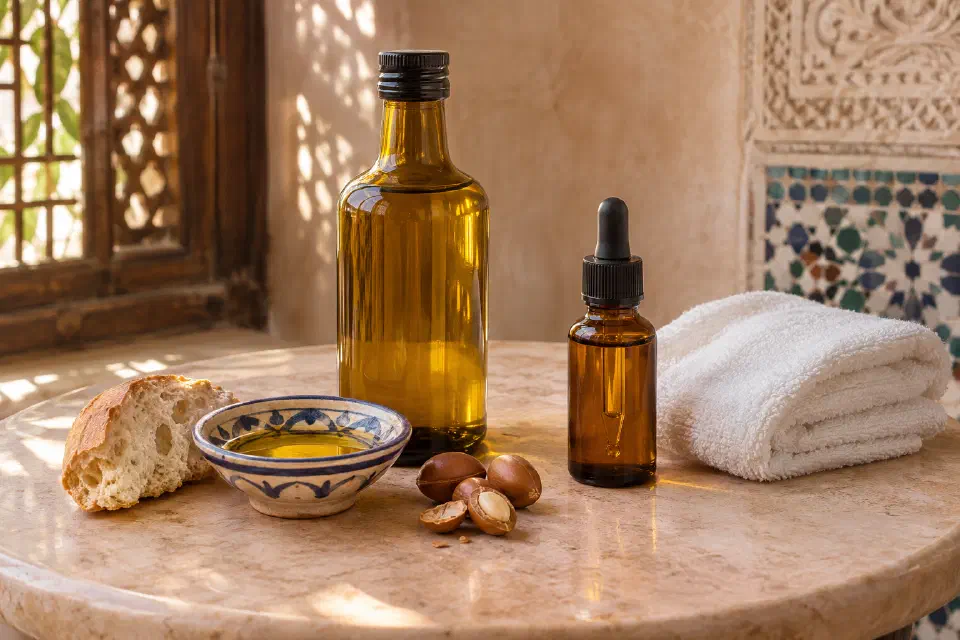
Argan oil belongs both in the Moroccan kitchen and in a skincare routine. The plant is the same, but the intended use matters when you choose a bottle. For food, look for oil clearly labelled as edible. For personal care, choose a cosmetic product with an ingredient list and instructions.
The key difference: food or personal care?
Choose culinary oil for food and cosmetic oil for the uses described by its manufacturer. Traditional culinary argan oil is pressed from roasted kernels; cosmetic oil is made from unroasted kernels. This distinction also appears in a study comparing the effects of roasting on the oil’s composition and stability. Study: Harhar and colleagues, 2011.
Smell, colour and bottle shape cannot establish a product’s intended use. Even “100% argan oil” does not, by itself, tell you whether the product is meant to be eaten.
How can it benefit the body and skin?
In food, the type of fat and what it replaces matter. Argan oil supplies mainly unsaturated fats. In a short trial involving 60 men, replacing butter with argan oil was followed by lower triglycerides and higher HDL. These blood markers do not establish prevention of heart attacks. Derouiche and colleagues, 2005.
In skincare, moisture retention is the relevant benefit. A study of 60 postmenopausal women found improved epidermal hydration and reduced water loss after 60 days of argan use. Its small, specific population limits generalisation. Boucetta and colleagues, 2014.
Use culinary oil within meals, accounting for its calories, and select cosmetic oil according to your skin’s needs. These uses have different purposes; neither calls for a “course” of oil or ever-increasing quantities.
One ingredient, two uses
Moroccan retailers distinguish between edible and cosmetic argan oils. Tamentino’s Arabic catalogue lists separate products for eating and for cosmetic use. The word “argan” alone is therefore not enough when comparing bottles, including when shopping in Morocco. Source: Tamentino.
What does roasting change?
Biomedica describes its culinary argan oil as pressed from roasted kernels, with a nutty flavour, and suggests couscous, salads and amlou as uses. Roasting helps explain the distinctive culinary character of this oil. Source: Biomedica.
However, aroma and colour do not replace a clear label. An oil that smells suitable for food still needs to be identified as edible by its producer.
Using culinary argan oil
Amlou is a useful starting point: a Moroccan spread made with almonds, edible argan oil and honey. Obio describes serving it with bread or pancakes for breakfast or as a snack. Here, the oil contributes to the flavour of the whole dish. Source: Obio.
The Maroc Collective collection in preparation includes culinary oil intended for use without heating. We will provide detailed uses and storage instructions from the selected product’s label. We do not assume that every argan oil has the same shelf life after opening or the same storage requirements.
What should you check before buying?
- Intended use: does the packaging clearly identify the oil as food or a cosmetic?
- Ingredients: is it pure argan oil or a blend?
- Producer and batch: is the responsible producer identified, and can the batch be traced?
- Instructions: are storage conditions, shelf life and directions available?
- Origin: do claims about a region or cooperative relate to this particular product?
Words such as “natural”, “traditional” and “Moroccan” do not answer all these questions.
Can you use the oils interchangeably?
We present culinary and cosmetic argan oils as separate products. Do not use oil sold as a cosmetic as a food ingredient. For personal care, follow the instructions for the specific cosmetic product.
For amlou or a finishing ingredient for a dish, start with the culinary oil page below. For personal care, explore the cosmetic oil page. The collection is still in preparation; final ingredients and specifications will be published once confirmed.