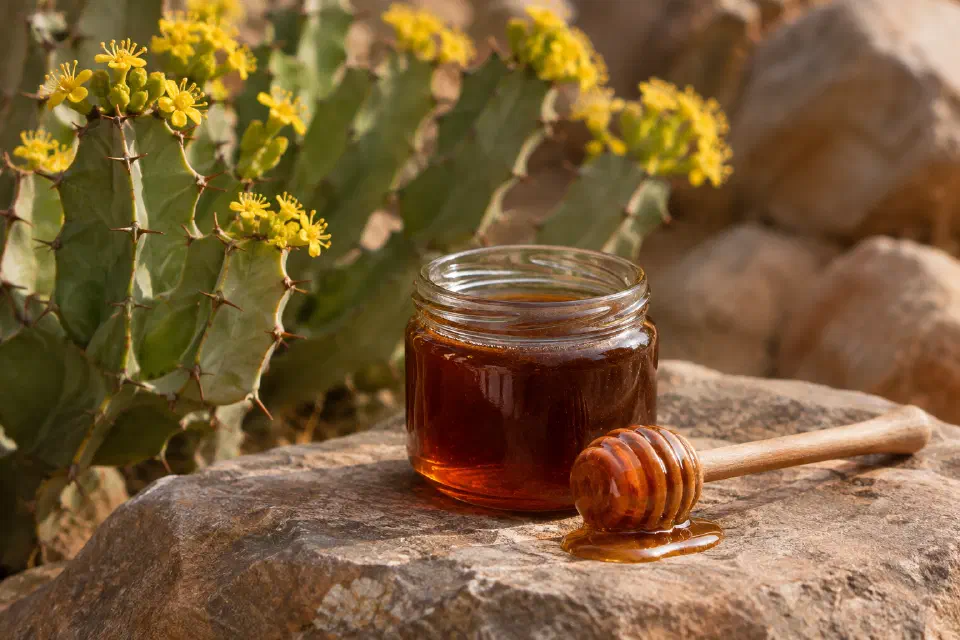
Daghmous honey invites you to look beyond sweetness. Moroccan descriptions mention dark amber colour, a little bitterness and a peppery finish. But what does the name on the jar actually tell you about the honey inside?
What does daghmous mean?
This honey is associated with nectar from the flowers of Euphorbia, also known as spurge. The plants’ fleshy, spiny stems can resemble cacti, but “cactus honey” is not a precise botanical identification.
Trade names need context. Dahabi distinguishes daghmous from Euphorbia echinus and zakkoum from Euphorbia resinifera. That explains this seller’s range; it does not establish a naming rule for every jar on the market. Dahabi — Arabic description.
Boutoub and colleagues discuss several Moroccan euphorbia honeys. A general name cannot replace information about the plant species and harvest location of an individual batch. Boutoub and colleagues — Foods, 2021.
Which honey benefits have been studied?
Honey may ease night-time cough during an upper respiratory infection. In a trial of 300 children aged 1–5, parents rated cough and sleep improvements more favourably after honey than placebo. The honeys tested were not daghmous. Cohen and colleagues, 2012.
This suggests symptom relief, not elimination of the infection’s cause. A stronger throat-tingling taste does not demonstrate greater effectiveness; daghmous flavour is a culinary characteristic.
What is known specifically about Euphorbia honey?
Moroccan samples contained phenolic compounds and showed antioxidant activity in laboratory tests. These findings support further research, not claims that eating daghmous treats inflammation or diabetes, or strengthens human immunity. Boutoub and colleagues, 2021.
Honey remains rich in sugars, so portion size matters, including when managing blood glucose. Never give honey to infants under 12 months because of botulism risk. CDC — honey and infants.
What does it taste like?
Chakir and colleagues describe Euphorbia resinifera honey as sweet, with a prickling sensation in the throat and a slightly bitter aftertaste. This characterises the honey type studied, rather than setting a compulsory flavour profile for every jar sold as daghmous. Chakir and colleagues — Moroccan honey characterisation.
When tasting, consider the aroma, initial sweetness and finish separately. Record your own impressions instead of searching for one required flavour note. Neither colour nor intensity alone confirms authenticity or batch quality.
Exploring it at the table
Our serving suggestion is to start with a small amount on plain bread. Then compare it with a little natural yoghurt or fresh cheese. Simple accompaniments make it easier to decide whether you enjoy the pronounced finish.
You can also try it in homemade amlou. Daghmous is not a required ingredient in that recipe: its character can shift the balance of almonds and argan oil. Make a small trial portion first.
Questions to ask before buying
- Which region and harvest does the honey come from?
- How does the producer describe its botanical origin, and what supports that declaration?
- Does the batch number connect the jar to a specification or available test results?
- What storage instructions and best-before date are provided?
Clear answers help you compare products. A plant photograph, a high price or a strong taste cannot replace documentation.
Honey in the Maroc Collective collection
Our planned euphorbia honey appears below. The precise plant species, origin and availability need confirmation for the batch; this website does not take sales orders. The AI illustration shows honey beside a euphorbia plant and does not document an actual harvest or supplier.