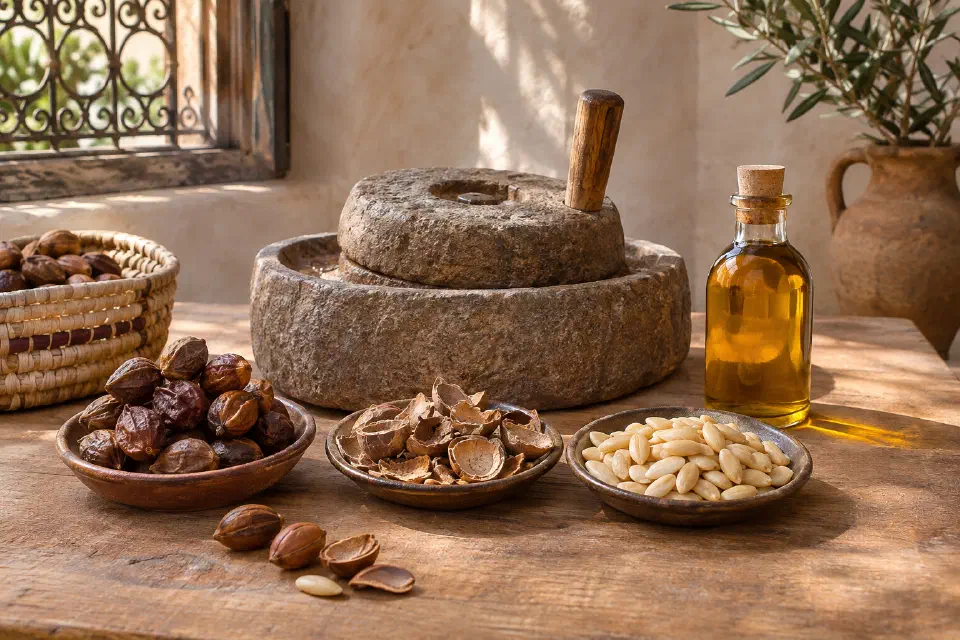
Several distinct tasks lie behind a bottle of argan oil. The fruit must be prepared, the kernels released from their hard shells and the oil extracted. A stone mill is part of this story, but it does not show the whole picture of production today.
First the fruit, then the kernel
Harvested fruits are dried and their pulp removed. The hard shells are then cracked and the kernels collected. These kernels are the raw material for the oil. The UN production outline presents these as separate stages — a useful distinction when watching a demonstration. United Nations — how argan oil is made.
Why does composition matter?
Production matters partly because argan oil contains unsaturated fatty acids alongside smaller fractions of tocopherols, sterols and polyphenols. An intervention in healthy men examined LDL susceptibility to oxidation and antioxidant-status markers, reporting favourable changes in selected measures after argan consumption. Cherki and colleagues, 2005.
These findings help explain nutritional interest, but do not guarantee disease protection. A laboratory marker is not a reduction in heart attacks, and “antioxidant” does not mean medicinal.
Choose oil with a clear intended use, traceable batch and appropriate storage instructions. A story about hand production does not establish superior health benefits. Our comparison of culinary and cosmetic oils discusses their nutritional and skincare uses in more detail.
What does roasting contribute?
In typical culinary oil production, the kernels are roasted; cosmetic oil uses unroasted kernels. Roasting helps develop the characteristic nutty aroma. “Cold-pressed” alone therefore does not tell you whether the kernels were roasted beforehand. These are separate stages. Gharby and Charrouf — review of the production process.
When choosing a bottle, check its intended use first. Aroma cannot replace the label. Our guide to culinary and cosmetic argan oil explains the distinction.
The stone mill and the mechanical press
In the traditional method, kernels are ground and the paste is kneaded with warm water added gradually. UNESCO describes this knowledge as skills passed between generations of women. UNESCO — practices and know-how concerning the argan tree.
A mechanical press extracts oil without kneading the paste with water. Settling and filtration follow pressing. Gharby and Charrouf describe this route in the review cited above. A demonstration with a hand mill therefore does not establish how the oil in a bottle for sale was produced.
Does a machine reduce quality?
There is no basis for treating the press itself as a flaw. Hilali and colleagues compared 21 samples from different origins and extraction methods; in that study, press extraction preserved the composition and physicochemical characteristics examined. This is a finding about those samples, not a certificate for every producer. Hilali and colleagues, 2005.
Rather than choosing between the words “handmade” and “modern”, ask for information about the actual product. A cooperative’s name should identify an organisation you can learn more about, and a description of the work should explain the real process.
Five questions before buying
- Who produced the oil, and who bottled it?
- Where did the raw material come from, and what is the batch number?
- Were the kernels roasted, and what is the finished oil intended for?
- How was the oil extracted, and was it filtered?
- What storage instructions and date appear on the label?
This is our practical checklist for a conversation with the seller. A general story about argan cannot replace answers about the bottle. If you choose culinary oil, you can later use it in amlou with almonds and honey.
The illustration for this article is an illustrative AI-generated scene. It does not document a facility or cooperative working with Maroc Collective.