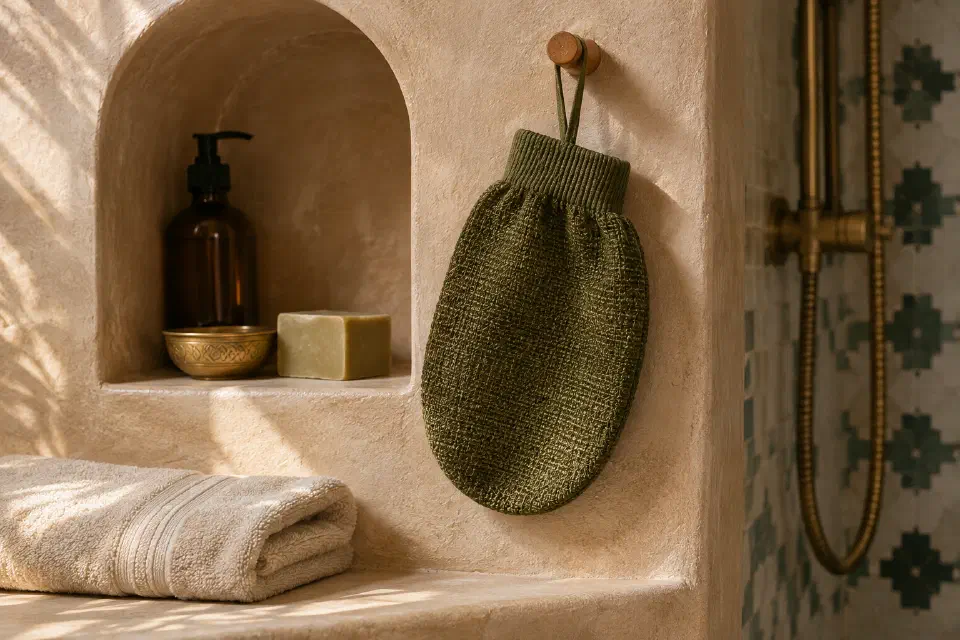
A kessa mitt takes up little bathroom space, but it calls for two useful habits: careful use and thorough drying. Its textured surface provides mechanical exfoliation. Scrubbing harder, or exfoliating at every bath, is not the aim.
What is a kessa mitt?
It is a textile mitt associated with the Moroccan hammam. Cooperative Arjana includes it alongside black soap in its ritual guide. Washing and exfoliating are separate stages. Cooperative Arjana — the hammam ritual.
The name alone does not specify the fabric, roughness or washing method. Before buying, check the material, intended body use and care label. Look at the cuff and seams too: the mitt should sit comfortably on your hand without scratchy edges.
What can gentle exfoliation offer?
Kessa removes some dead cells from the skin’s outer surface, which may leave it feeling smoother. This is a surface effect; harder rubbing does not mean greater benefit. AAD advises matching exfoliation to skin type. AAD — mechanical exfoliation.
Choose this step when smoothing is your aim and your skin tolerates it. Do not treat kessa as a way to remove cellulite, stretch marks or “toxins”; the cited dermatology guidance does not establish those uses.
Apply a suitable moisturiser afterwards. Stinging signals excessive intensity for your skin: shorten or skip the next session. A mitt is optional, not a requirement for healthy skin.
How to use a kessa mitt, step by step
- Have a clean mitt ready and read its instructions. Start with a comfortably warm bath or shower.
- If using cosmetic black soap, follow its label and rinse it off thoroughly before exfoliating.
- Wet the mitt and try light, short strokes on a small area of the body. Avoid repeatedly rubbing the same spot.
- Stop if it feels uncomfortable. Rinse your body and apply a moisturizer.
Exfoliate gently, avoiding cuts and sunburn. Frequency depends on your skin and the method. If your skin is sensitive or you use retinoids, discuss exfoliation with a dermatologist. American Academy of Dermatology — safe exfoliation.
Do not increase pressure just to produce visible flakes. A body mitt should not automatically be treated as a facial accessory. For the full sequence, see hammam at home, step by step; our black soap guide explains how to choose the soap.
How should you wash it afterwards?
Remove residue and clean the mitt according to its label. For its own kessa, Aroma-Zone recommends hand washing with mild soap or detergent, followed by air drying. This is a product-specific example, not a specification shared by every mitt. Aroma-Zone — cleaning and care.
Do not choose a wash temperature from the name “kessa” alone. Ask the seller if machine washing, tumble drying or suitable cleaning products are not covered. Keep the label or a photograph of it: after a few weeks it is easy to confuse instructions for different accessories.
How should you dry and store it?
After washing, leave it unfolded or hanging in a ventilated place, away from running water. Check the cuff and inside before putting it away. A toiletry bag is for storing a dry mitt; a closed bag is not a drying space. OASIAC — caring for a kessa mitt.
When travelling, allow time for the accessory to dry before packing. On returning home, inspect the fabric and seams before putting it back in the cupboard.
When should you replace it?
There is no single replacement interval for every fabric. Follow the instructions and inspect its condition: tears, damaged seams or a surface that becomes uncomfortable are reasons to stop using it. OASIAC — checking wear.
Kessa at Maroc Collective
Below are the kessa mitt, black soap and Hammam Set from our planned collection. The mitt’s material, producer and final care instructions remain to be confirmed. The photorealistic illustration is an AI-generated scene, not a photograph of a particular item on sale.