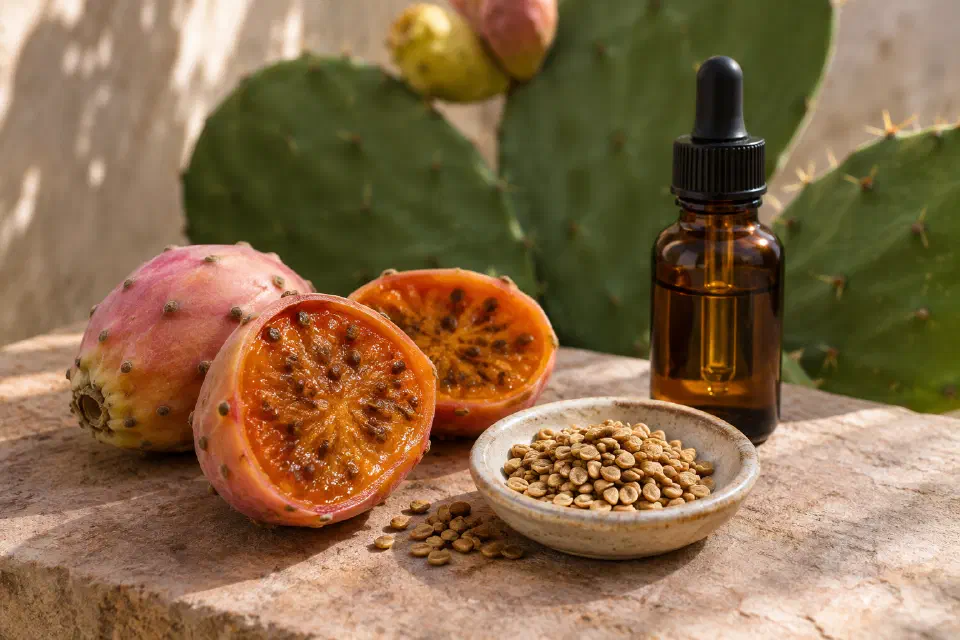
A small bottle, a cactus fruit on the label and a promise of special skincare. What does “prickly pear oil” actually mean? The part of the plant matters: seed oil is different from fruit juice, an extract or an infusion in another oil.
From fruit to bottle
The oil comes from the seeds of Opuntia ficus-indica. In the process described by Typology, the seeds are separated from the fruit, washed and dried. The dry seeds are pressed, then the resulting oil is filtered to remove pressing residues. Typology — production process.
These are distinct stages, so a picture of the fruit cannot tell you how the contents of a bottle were made. If you want cold-pressed oil, look for an explicit statement from the producer. The word “natural” does not establish the extraction method.
We do not give a universal figure for the kilograms of fruit needed to produce a litre of oil. Yield depends on factors including the raw material and extraction method. Kadda and colleagues compared extraction methods using seeds from eastern Morocco; their study is not a specification for every commercial batch. Extraction study — PubMed.
Why is prickly pear seed oil of interest in skincare?
Analysis of Moroccan seeds found a high proportion of linoleic acid and tocopherols, members of the vitamin E family. This describes composition; quantities vary with the sample and extraction method. Kadda and colleagues, 2021.
As an oil, it may act as an emollient, leaving a lubricating film and improving softness. That is an expected ingredient-category function, not a comparative clinical result for every bottle. DermNet explains emollients.
A reasonable aim is to complement care for skin that feels dry or rough. Composition alone does not prove wrinkle or pigmentation reduction; those claims need finished-product studies. Follow the cosmetic’s instructions and observe tolerance. Oil does not replace a product with established sun protection.
Seed oil, infused oil or blend?
Read the full ingredient list, not just the name on the front. The INCI name for the seed oil is Opuntia Ficus-Indica Seed Oil, also listed in Jedwards’ ingredient documentation. Jedwards — ingredient listing on UL Prospector.
- Seed oil: look for that name and check whether the product is described as a single ingredient.
- Oil blend: contains other oils too. It may suit your needs, but its price is not directly comparable with pure seed oil.
- Infused oil: plant material is steeped in a carrier oil. Ask which part of the prickly pear and which carrier oil were used.
- Serum or cream with prickly pear: a finished formula; check all ingredients and the intended use.
An INCI name identifies the declared ingredient. By itself, it does not authenticate the product or establish the origin of its batch.
Five things to check before buying
- Ingredients: is it pure oil, a blend or another type of cosmetic?
- Method: are extraction and any further processing described?
- Origin: where was the raw material harvested, the oil pressed and the product bottled?
- Traceability: does the seller provide the producer, batch number and shelf-life information?
- Packaging: are volume, closure and storage conditions specified?
Compare prices for the same volume while allowing for differences in composition. A high price, dark bottle or Moroccan design cannot replace product documentation.
Using it in your routine
Follow the particular cosmetic’s directions for purpose, quantity and application area. Do not apply instructions for pure oil to a serum with a different formula. Follow the storage label; Typology advises keeping its oil tightly closed and protected from light, heat and moisture. Typology — storage.
A chemical analysis of an ingredient does not promise a particular result on skin. Choose according to product documentation and your needs, rather than treating “rejuvenating” language as a guarantee.
Prickly pear seed oil at Maroc Collective
Below you will find the page for our planned prickly pear seed oil. Its origin, ingredients and specification still need confirmation; the process described here does not document our supplier. The dedicated photorealistic illustration was generated with AI and is illustrative.