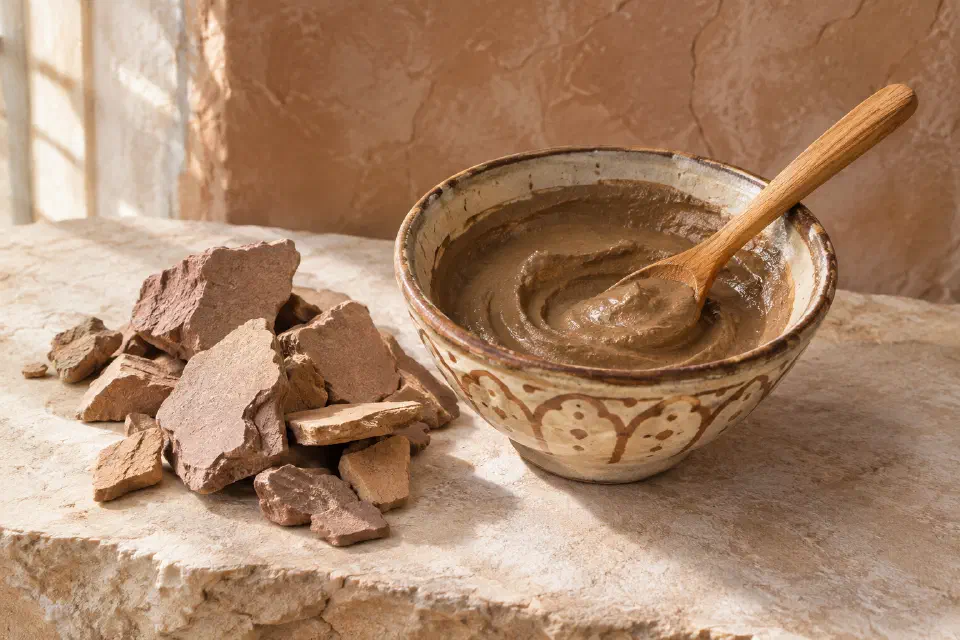
One label says “rhassoul”, another “ghassoul”, while photographs show dry pieces, fine powder or a creamy paste. How can you compare them? Start by separating the clay’s name from its format and the ingredients of a particular cosmetic product.
Rhassoul and ghassoul: two names for the same clay
Rhassoul and ghassoul are alternative names for Moroccan cosmetic clay. Labels may also use the INCI name “Moroccan Lava Clay”. A different spelling does not indicate a different product grade or better quality. Aroma-Zone — names and INCI.
When comparing two packs, begin with the full ingredient list. Dry clay and a mask containing clay need not have the same composition. Check fragrance, oils and other additions in the specific product description instead of inferring them from the name on the front.
How might rhassoul benefit skin and hair?
Clay is used mainly to take up excess sebum and cleanse the surface. Aroma-Zone describes these properties for its ingredient, including haircare use. This is supplier documentation, not an independent clinical trial. Aroma-Zone — rhassoul properties.
A practical goal is a less greasy feel after rinsing, rather than a permanent reduction in sebum production. Results depend on formulation, quantity and skin condition; extra degreasing may be unwelcome on dry skin.
Magnesium in the mineral does not demonstrate correction of a deficiency through a mask. The sources reviewed did not provide robust human evidence for treating acne or “detoxifying” the body with rhassoul. Choose it for a specific cosmetic purpose and assess comfort after rinsing.
Where does rhassoul come from?
A 2018 study by Amakrane and colleagues describes the Jbel Rhassoul deposit near Missour, in Morocco’s Boulemane Province. The samples were dominated by magnesium-rich stevensite-type clay belonging to the smectite group. Mineralogical study — Université de Liège.
A deposit description provides geographical and mineralogical context. It does not certify the origin of every pack in a shop. If traceability matters to you, ask the seller about the producer, country of origin and batch details. The place of packing need not be the place where the material was extracted.
Pieces, powder or a ready-made paste?
marocMaroc describes rhassoul being dried in the sun and, optionally, ground. The dry material is mixed with liquid to form a paste for cosmetic use. marocMaroc — rhassoul.
Distinguish these three formats before buying:
- Dry pieces — check the preparation instructions on the pack.
- Powder — find out whether it is clay alone or a blend.
- Ready-made paste or mask — read the complete ingredients and directions; do not assume it needs added water.
Choose a format that fits your routine. Powder alone is not proof of purity, and a ready-made paste does not reveal its clay content. A photograph cannot replace the label either.
Where does it fit into a hammam ritual?
Rhassoul is associated with Moroccan skin and hair care. marocMaroc describes its use in masks. marocMaroc — cosmetic ingredients.
Treat it as a separate, optional stage in a home routine. Black soap, a kessa mitt and clay have their own instructions: you do not need to use all three at every bath. Our hammam at home guide explains the sequence, while the black soap article focuses on the soap itself.
What should you check before first use?
Look for the intended use, preparation method, application time and rinsing directions. Do not automatically transfer body-mask instructions to your face or hair. We do not prescribe a single water ratio or application time for every formula.
Avoid breathing in the powder. Protect the dry product from moisture and close its packaging after use. Aroma-Zone — precautions and storage.
“Natural” and “Moroccan” are not promises of a particular result for every skin type. This guide describes the material and its place in cosmetic care; it does not attribute disease treatment or bodily “detox” to it.
Rhassoul at Maroc Collective
We are preparing a hammam-inspired collection. Below are the rhassoul, black soap and Hammam Set pages. Our clay’s source, processing and final directions remain to be confirmed. The photorealistic illustration was generated with AI and does not document a particular batch or supplier.