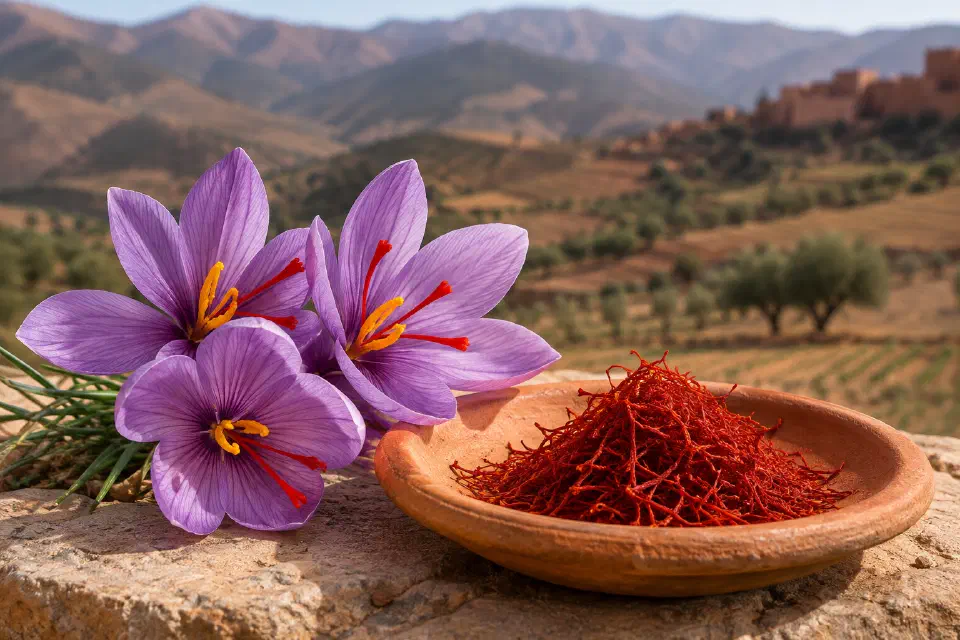
A few red threads can become the starting point for a story about Moroccan cooking. Before adding saffron to a dish, though, take a closer look at the name on the packet. “Taliouine” points to a place and a growing tradition; it is neither a recipe name nor a colour description.
A place behind the name
Taliouine is in Morocco’s Taroudant province. A Souss Massa regional publication describes a saffron production area around Taliouine and Tazenakht, in the foothills of the Siroua massif. The name therefore refers to a growing area beyond the town itself. Souss Massa region — local products.
ORMVAO lists AOP “Safran de Taliouine” among its regional products. AOP stands for the French Appellation d’Origine Protégée, meaning protected designation of origin. It is worth distinguishing this name from the general description “Moroccan saffron”. ORMVAO — regional products.
For an individual product, ask for documentation supporting its stated origin and designation. A name in a listing or a mountain photograph does not verify a batch.
Saffron, mood and sleep: what has been studied?
Promising human findings concern wellbeing and sleep. In a four-week trial of 128 adults reporting low mood, a standardised saffron extract improved some mood ratings at the higher tested dose, but not the lower one. Outcomes relied on self-report. Kell and colleagues, 2017.
A separate small placebo-controlled trial reported improved subjective sleep quality in adults with sleep complaints. Larger, longer studies with objective measurements are needed. Lopresti and colleagues, 2020.
A standardised extract is not equivalent to a few threads in food. These findings do not establish the same benefit from a culinary serving of Taliouine saffron or a “therapeutic dose” of spice. Enjoy its aroma and colour in cooking. Discuss persistent mood or sleep difficulties with a clinician and do not replace treatment with saffron.
From purple flowers to red threads
The spice consists of the dried stigmas of Crocus sativus flowers. Slow Food describes the autumn harvest in Taliouine: flowers are gathered at dawn, their stigmas separated by hand and then dried. Those tiny threads involve careful work. Slow Food — Taliouine saffron.
An account of traditional production is not a specification for every packet. Drying method, time since harvest and storage are separate questions for the producer. We do not present a single harvest yield as a guarantee for every farm.
What should you check before buying?
When comparing two offers, start with information that can be linked to the actual product:
- Origin: where was the saffron grown, and where was it packed?
- Producer and batch: can you identify the responsible business and batch number?
- Form and ingredients: are you buying threads, powder or a spice blend?
- Net weight: compare prices for the same quantity, allowing for differences between products.
- Dates and storage: are shelf life, storage instructions and, where available, harvest year stated?
- Claimed designation: if the offer refers to AOP, what supporting documentation can the seller provide?
These questions help separate marketing language from verifiable information. A photograph of red threads or a home observation of colour in water cannot replace traceability or laboratory analysis.
In the kitchen: start with a recipe
For a first attempt, choose a recipe that specifies the quantity of saffron and when to add it. If it calls for soaking the threads, use the liquid as directed too. Do not assume that a spice blend containing saffron should be measured in the same way as saffron alone.
Keep the original label and follow the producer’s storage instructions. This keeps batch and shelf-life information available after opening the packet.
Saffron at Maroc Collective
Below are the pages for our planned saffron and Pantry Set. Batch origin, any AOP designation and the final specification of our proposed product still need confirmation. This regional overview does not document our supplier. The dedicated photorealistic AI image is illustrative.